I love visiting caves. I don't know why. I've been to several caves before, including Koněpruské Jeskyně in the Czech Republic, Mammoth Caves in the USA, Lumiang and Sumaging Caves in the Philippines, Grutas de Lanquin in Guatemala, Batu Caves in Malaysia, and Kawgun Cave and Yathaypyan Cave in Myanmar. So when I found out that there are some caves that can be visited in Israel, we made plans to check it out. Hence we did an excursion to Avshalom Cave, at the Judean Hills, east of Beit Shemesh.
Showing posts with label caving. Show all posts
Showing posts with label caving. Show all posts
11 June 2015
27 March 2015
Meandering in Myanmar: Yathaypyan Cave in Hpa-An
Yathaypyan Cave is actually the first cave I visited when I was in Hpa-An for a day. While riding a motorcycle taxi, we went to the main road again and followed the Thanlwin River, crossing it once, and then driving on a dirt road for a few minutes. We approached a limestone hill, and sure enough, there was an opening, and from there we ventured forward.


23 March 2015
Meandering in Myanmar: Kawgun Cave and Kyauk Kalap in Hpa-An
Mawlamyine was my base when I was in southern Myanmar. However, I also did daytrips to other places. One of the places I loved was Hpa-An, which was actually located in Karen State, two hours away from Mawlamyine by bus. So I went to the bus station after eating my breakfast of Shan noodles, and boarded the rickety bus that took me to Hpa-An.
30 January 2015
Meandering in Malaysia: Batu Caves
As I have mentioned in a previous post, while I had Myanmar as my main destination, for economic reasons, I opted to add some stops in other countries. So instead of flying directly from Berlin to Yangon, I opted to fly to Kuala Lumpur instead, as fares were cheaper that way, even if I factored in the extra flight connecting Kuala Lumpur and Yangon. And since I haven't been to Malaysia before, I opted to spend 3 nights in the city and check it out as well. I arrived on December 14 in the evening, and the next day, I set off to explore Batu Caves, easily reached by the commuter train from where I was staying.
01 April 2012
Gallivanting in Guatemala: Grutas de Lanquín
After heading to Semuc Champey, my body was already tired and beaten up. That trail was quite difficult, and the ride at the back of the pick-up truck was very bouncy as well. But we didn't stop yet. There's still the caves in nearby Lanquín to visit. And that was our last activity for that day.
28 June 2010
Picture Entry: Banaue and Sagada
While I was in the Philippines, I took a trip to actually see what the country of my birth has to offer. After all, I felt bad for having traveled many other places around the world and yet I haven't seen the Philippines yet. In my previous picture entry, I featured Intramuros and Old Manila. This time, I will show pictures of Banaue and Sagada, two cool towns in the Philippine Cordilleras.
.JPG)
First, let me start with the people. The area is inhabited by the indigenous people that are collectively called the Ifugao. They are known for their bright-red colored weaving, as the above picture depicts. I know that these six lovely people are only dressed as these due to the fact that travelers like taking pictures of them, but still, they were good photograph subjects. Normal wear of the Ifugao is pretty much just like other Filipinos.
.JPG)
Banaue is the site of one of the Philippines' UNESCO World Heritage Sites: the Banaue Rice Terraces. And yes, the place is spectacular. I took several shots of the sweeping views from the top of the mountains. This is a shot that only shows a small part of the mountain, as my camera cannot fit the whole thing in one shot.
.JPG)
Unfortunately, this is also a World Heritage Site in Danger. Plenty of the Ifugao don't maintain this anymore, as they somehow deem that tourism is a more fruitful endeavor than agriculture. This is one of those situations in which visiting the place may actually damage it: the influx of tourists provide a more lucrative industry for the natives, which then lessens their time to actually maintain the place. Other Ifugao also think that it is better to go down to the city and earn a living there, rather than stay in the mountains and plant rice. The picture above actually shows some signs of erosion, due to the lack of maintenance of the rice terraces.
.JPG)
I didn't just view the terraces from afar: I also hiked them. I did a few hikes between the villages that are scattered within the rice terraces. I therefore followed several paths that are actually the borders of the rice terraces. Some aren't so bad, like the picture above, but others are rather tricky, since they are terraces in the mountains after all, so one side would be a rice paddy, and the other side would be a steep mountain side. Good thing I was good with my balance and didn't fall and cause an accident.
.JPG)
After spending a few days in Banaue, I went to Sagada, and did some caving. On the way to the caves, I saw some karst formations, such as depicted above, complete with hanging coffins. See if you can find the hanging coffins in the picture.
.JPG)
I did the Sagada Cave Connector, and it was a hard trek. My whole body was sore. I didn't take plenty of pictures inside, as the inside was wet, and we had to swim some parts of the cave. The picture above perhaps provides an idea of what it was like inside. We had gas lanterns to light our way inside, and after 4 hours, we emerged all tired and sore.
So this is my second picture entry for the Philippines trip. There's one more coming, and that will be the last.
.JPG)
First, let me start with the people. The area is inhabited by the indigenous people that are collectively called the Ifugao. They are known for their bright-red colored weaving, as the above picture depicts. I know that these six lovely people are only dressed as these due to the fact that travelers like taking pictures of them, but still, they were good photograph subjects. Normal wear of the Ifugao is pretty much just like other Filipinos.
.JPG)
Banaue is the site of one of the Philippines' UNESCO World Heritage Sites: the Banaue Rice Terraces. And yes, the place is spectacular. I took several shots of the sweeping views from the top of the mountains. This is a shot that only shows a small part of the mountain, as my camera cannot fit the whole thing in one shot.
.JPG)
Unfortunately, this is also a World Heritage Site in Danger. Plenty of the Ifugao don't maintain this anymore, as they somehow deem that tourism is a more fruitful endeavor than agriculture. This is one of those situations in which visiting the place may actually damage it: the influx of tourists provide a more lucrative industry for the natives, which then lessens their time to actually maintain the place. Other Ifugao also think that it is better to go down to the city and earn a living there, rather than stay in the mountains and plant rice. The picture above actually shows some signs of erosion, due to the lack of maintenance of the rice terraces.
.JPG)
I didn't just view the terraces from afar: I also hiked them. I did a few hikes between the villages that are scattered within the rice terraces. I therefore followed several paths that are actually the borders of the rice terraces. Some aren't so bad, like the picture above, but others are rather tricky, since they are terraces in the mountains after all, so one side would be a rice paddy, and the other side would be a steep mountain side. Good thing I was good with my balance and didn't fall and cause an accident.
.JPG)
After spending a few days in Banaue, I went to Sagada, and did some caving. On the way to the caves, I saw some karst formations, such as depicted above, complete with hanging coffins. See if you can find the hanging coffins in the picture.
.JPG)
I did the Sagada Cave Connector, and it was a hard trek. My whole body was sore. I didn't take plenty of pictures inside, as the inside was wet, and we had to swim some parts of the cave. The picture above perhaps provides an idea of what it was like inside. We had gas lanterns to light our way inside, and after 4 hours, we emerged all tired and sore.
So this is my second picture entry for the Philippines trip. There's one more coming, and that will be the last.
07 June 2010
Backpacker Bootcamp
If Banaue was backpacker bliss, Sagada was backpacker bootcamp. I feel pain all over my body, all of my limbs, my back, everything. Well, let me explain.
I headed to Sagada one Sunday morning, by catching the 8:30 AM jeep that leaves Banaue. This jeep goes all the way to Bontoc, and from there, I caught another jeep to Sagada. The whole trip took the whole morning, and I arrived in Sagada around lunchtime.
While in the jeep for Bontoc, I met an American girl and a Spanish guy couple. They were aloof, so whatever. In the same jeep, there was a Korean guy and his Filipino girlfriend. And later on, three girls showed up, two were from Singapore, and another one was from Korea. We started chatting while passing by one of the most dangerous roads here in the Philippines. And by the time we reached Bontoc, we were friends and functioned as one group.
In the meantime, I also befriended two locals, two women and their kids. It's funny they always called me with "sir" even though they definitely looked older than me. They were proud of the fact that the road from Banaue to Bontoc was getting paved; apparently that was only a development last year. They even invited me to stay at their place, somewhere in Mount Polis, which is reachable by one of the highest highways in the Philippines. Obviously, I refused.
Anyway, by the time we reached Bontoc, this was about 12:00 PM. The American-Spanish couple took the jeep for Baguio, while we took the jeep for Sagada. In the jeep, there was another foreigner, a Canadian this time, and he happened to be from Toronto. I told him that I lived just across the border in Buffalo. We ended up joining forces, and I ended up staying at his hotel as well.
The Canadian and I had lunch, and after that, we figured we go caving. So in Sagada, there are three things one can do with caves. One can go to the small Lumiang Burial Caves, and that was easy. One can also go to the larger Sumaging Caves, which is a two-hour caving trek. Or, for the fit and courageous and not claustrophobic, one can do the Sagada Cave Connection Trek, which means entering from the Lumiang Burial Cave, and four hours later, one gets out of the Sumaging Cave. It was strenuous, and one would get wet.
So, the Canadian and I went to the guide dispatch center, and weighed everything. He only had flip-flops, and I have a pair of flip-flops and hiking boots. River sandals are recommended according to the guidebooks, but the guides told us that our flip-flops are fine. So, one guide and the two of us, that costs PHP 800, which breaks down to PHP 400 per person.
While heading to the entrance, we saw the Korean couple and the Singaporean girls. We coerced them into joining, so our group ended up being composed of seven people, and three guides. Little did we know how hard the adventure that awaited us.
So how do I describe this? The Sagada Cave Connection trek involved several tricky and technical caving maneuvers. If I didn't do Mammoth Cave a couple of years ago, I would be very hesitant in doing this. In fact, after doing this, the 4-hour walking tour of Mammoth Cave that I did in Kentucky back in 2009 seemed like a walk in the park.
I sort of did my homework for this one, so I brought enough zip lock bags to waterproof my camera, wallet, and an extra change of shirt. I decided to go with the flip-flops, as I don't have river sandals. It turned out that it was a good thing, and later on, it was more advisable to go barefoot, and I did go barefoot for most of the time inside, putting my flip-flops in my drawstring bag.
So what are the things that I did here? First, let me emphasize the smallness of the crevices. The opening looked really big, but we had to go through several small holes: I don't think Rosie O'Donnell would fit in several of those. The rocks become slippery the farther one goes down, due to the moisture. There are two main types of rock inside: limestone, which is slippery and sharp, and sandstone, which provides a good grip even with your feet.
Most maneuvers involve scrambling: all four limbs are used, and pretty much it is some variation of wall- or rock-climbing when one goes up, and rappelling down using ropes down vertical walls going down. There are also a few holes in which one basically takes a leap of faith: one cannot see where one will put one's foot, and one just has to trust the guide in leading the way.
There's also a water component. There are sections that can only be crossed by swimming the cold underground water. These usually provided the much-needed refreshment after scrambling up and down the boulders. Unfortunately, these underground pools were located before the bat chambers that were full of guano (bat shit). That meant that four hours later, we emerged stinking and dirty.
So what happens to someone after doing the Cave Connection trek? Every muscle in my body is sore. I have several cuts and bruises all over the place. My feet are raw. And dinner that night was the best I've ever had. The Korean group (who were all staying in one hotel different from the hotel where the Canadian and I were staying) invited us for dinner, as they asked their hotel to cook for them. That was awesome, and the ice cold San Miguel beer made everything complete.
After dinner, we walked back to our hotel and plopped in bed. Sagada was so quiet, I could hear the crickets and see the stars.
So, now that I have already done everything I wanted to do in Sagada, I boarded a Baguio-bound bus from Sagada, and six hours later, I am here now in Baguio. My body is still sore, and the nerve-frying Halsema Highway didn't help, nor was sitting at the very back of the bus. In the end, it was all fun, somehow this earns me bragging rights for caving. I felt like Gollum from The Lord of the Rings as I was doing that trek. The only thing different was that there wasn't a ring involved.
I wish I took more pictures underground. However, Sagada's caves aren't something to see. Rather, they're something to experience. I did attempt to capture a few shots here and there when my hands are dry, but capturing a few shots of the whole cave experience won't do justice at the awesome yet grueling ordeal of the Cave Connection. My camera did capture a few memories of the place, but my body captured a lot.
So that's the second part of my backpacking trip. It was fun, I made new friends, and now it's time to go home. Tomorrow I board a Manila-bound bus and conclude this trip in the northern Philippines. Now I can say that I have frolicked in the Philippines!
So where would I go caving next when I visit the Philippines again? I heard that Samar has some awesome cave systems, maybe I should try those next time. In the meantime, improving my rock-climbing skills sounds like a good idea.
.JPG)
(Narrow Streets, from my Bogotá, Colombia Series)
I headed to Sagada one Sunday morning, by catching the 8:30 AM jeep that leaves Banaue. This jeep goes all the way to Bontoc, and from there, I caught another jeep to Sagada. The whole trip took the whole morning, and I arrived in Sagada around lunchtime.
While in the jeep for Bontoc, I met an American girl and a Spanish guy couple. They were aloof, so whatever. In the same jeep, there was a Korean guy and his Filipino girlfriend. And later on, three girls showed up, two were from Singapore, and another one was from Korea. We started chatting while passing by one of the most dangerous roads here in the Philippines. And by the time we reached Bontoc, we were friends and functioned as one group.
In the meantime, I also befriended two locals, two women and their kids. It's funny they always called me with "sir" even though they definitely looked older than me. They were proud of the fact that the road from Banaue to Bontoc was getting paved; apparently that was only a development last year. They even invited me to stay at their place, somewhere in Mount Polis, which is reachable by one of the highest highways in the Philippines. Obviously, I refused.
Anyway, by the time we reached Bontoc, this was about 12:00 PM. The American-Spanish couple took the jeep for Baguio, while we took the jeep for Sagada. In the jeep, there was another foreigner, a Canadian this time, and he happened to be from Toronto. I told him that I lived just across the border in Buffalo. We ended up joining forces, and I ended up staying at his hotel as well.
The Canadian and I had lunch, and after that, we figured we go caving. So in Sagada, there are three things one can do with caves. One can go to the small Lumiang Burial Caves, and that was easy. One can also go to the larger Sumaging Caves, which is a two-hour caving trek. Or, for the fit and courageous and not claustrophobic, one can do the Sagada Cave Connection Trek, which means entering from the Lumiang Burial Cave, and four hours later, one gets out of the Sumaging Cave. It was strenuous, and one would get wet.
So, the Canadian and I went to the guide dispatch center, and weighed everything. He only had flip-flops, and I have a pair of flip-flops and hiking boots. River sandals are recommended according to the guidebooks, but the guides told us that our flip-flops are fine. So, one guide and the two of us, that costs PHP 800, which breaks down to PHP 400 per person.
While heading to the entrance, we saw the Korean couple and the Singaporean girls. We coerced them into joining, so our group ended up being composed of seven people, and three guides. Little did we know how hard the adventure that awaited us.
So how do I describe this? The Sagada Cave Connection trek involved several tricky and technical caving maneuvers. If I didn't do Mammoth Cave a couple of years ago, I would be very hesitant in doing this. In fact, after doing this, the 4-hour walking tour of Mammoth Cave that I did in Kentucky back in 2009 seemed like a walk in the park.
I sort of did my homework for this one, so I brought enough zip lock bags to waterproof my camera, wallet, and an extra change of shirt. I decided to go with the flip-flops, as I don't have river sandals. It turned out that it was a good thing, and later on, it was more advisable to go barefoot, and I did go barefoot for most of the time inside, putting my flip-flops in my drawstring bag.
So what are the things that I did here? First, let me emphasize the smallness of the crevices. The opening looked really big, but we had to go through several small holes: I don't think Rosie O'Donnell would fit in several of those. The rocks become slippery the farther one goes down, due to the moisture. There are two main types of rock inside: limestone, which is slippery and sharp, and sandstone, which provides a good grip even with your feet.
Most maneuvers involve scrambling: all four limbs are used, and pretty much it is some variation of wall- or rock-climbing when one goes up, and rappelling down using ropes down vertical walls going down. There are also a few holes in which one basically takes a leap of faith: one cannot see where one will put one's foot, and one just has to trust the guide in leading the way.
There's also a water component. There are sections that can only be crossed by swimming the cold underground water. These usually provided the much-needed refreshment after scrambling up and down the boulders. Unfortunately, these underground pools were located before the bat chambers that were full of guano (bat shit). That meant that four hours later, we emerged stinking and dirty.
So what happens to someone after doing the Cave Connection trek? Every muscle in my body is sore. I have several cuts and bruises all over the place. My feet are raw. And dinner that night was the best I've ever had. The Korean group (who were all staying in one hotel different from the hotel where the Canadian and I were staying) invited us for dinner, as they asked their hotel to cook for them. That was awesome, and the ice cold San Miguel beer made everything complete.
After dinner, we walked back to our hotel and plopped in bed. Sagada was so quiet, I could hear the crickets and see the stars.
So, now that I have already done everything I wanted to do in Sagada, I boarded a Baguio-bound bus from Sagada, and six hours later, I am here now in Baguio. My body is still sore, and the nerve-frying Halsema Highway didn't help, nor was sitting at the very back of the bus. In the end, it was all fun, somehow this earns me bragging rights for caving. I felt like Gollum from The Lord of the Rings as I was doing that trek. The only thing different was that there wasn't a ring involved.
I wish I took more pictures underground. However, Sagada's caves aren't something to see. Rather, they're something to experience. I did attempt to capture a few shots here and there when my hands are dry, but capturing a few shots of the whole cave experience won't do justice at the awesome yet grueling ordeal of the Cave Connection. My camera did capture a few memories of the place, but my body captured a lot.
So that's the second part of my backpacking trip. It was fun, I made new friends, and now it's time to go home. Tomorrow I board a Manila-bound bus and conclude this trip in the northern Philippines. Now I can say that I have frolicked in the Philippines!
So where would I go caving next when I visit the Philippines again? I heard that Samar has some awesome cave systems, maybe I should try those next time. In the meantime, improving my rock-climbing skills sounds like a good idea.
.JPG)
09 March 2009
Spending a Day in the Underworld
I suppose some people may be wondering where in the planet is Linguist-in-Waiting? I mentioned casually a couple of posts behind that I will be out of town during Spring Break. So yes, right now, I am not in Buffalo. I am in and around Appalachia.
A good friend of mine and I are currently taking a road trip, and right now, we are in Charleston, West Virginia. This happens to be the second of four locales we are visiting. I am right now on top of a bed in a little hotel, accessing the wireless Internet connection. I just crossed a state boundary earlier today, and almost encountered a tornado while on the highway.
So let me clarify. Yesterday, we just drove for ten hours, from Buffalo, NY to Cave City, KY. Yup, that's Kentucky, home of the horses. However, we didn't cross three state borders to see the horses. Instead, we went to Kentucky to see the longest cave system in the world, none other than Mammoth Caves National Park. So what we did was just drive all day yesterday, and after that, we plopped in a hotel and slept.
The next day (today), we went to the national park and took a guided tour. We booked the Grand Avenue Tour, which is the longest guided tour that doesn't require crawling or rappelling down crevices and holes. It lasted for four and a half hours. It was strenuous, it was slippery, but it was fun. It was also a good workout for my goal of mountain-climbing in Borneo. I got sweaty, but I didn't lose my breath. I saw plenty of rocks, I saw gypsum flowers, I saw stalactites and stalagmites, and I also experienced darkness. There were a few times in which the park rangers would turn the lights off, and there was practically no light, just a dark and gloomy place.
Interestingly enough, I hadn't made much use of my camera inside. I did take a few photos, but in relation to other places that I took photos of, I wasn't taking copious pictures in the four and a half hours I was underneath the earth. Perhaps it was because I was busy holding to the handrails and making sure I wasn't slipping.

The above photo is the usual scene inside. Mammoth Cave is mostly a rock cave. There aren't a lot of dripping water inside. There are plenty of slot canyons, where one has to practically go single file inside.

This is a prettier picture perhaps. This is near the Frozen Niagara Room, which is filled with stuff that look like these. This reminds me of when I went to central Czech Republic and saw Konepruske Jeskyne (Koneprusy Caves), which was the largest cave system in Central Europe.
So that was today. We are spending the night here in West Virginia, and the plan is to see this city tomorrow morning, and be on the road again so by tomorrow night, we'll be in a different state.
A good friend of mine and I are currently taking a road trip, and right now, we are in Charleston, West Virginia. This happens to be the second of four locales we are visiting. I am right now on top of a bed in a little hotel, accessing the wireless Internet connection. I just crossed a state boundary earlier today, and almost encountered a tornado while on the highway.
So let me clarify. Yesterday, we just drove for ten hours, from Buffalo, NY to Cave City, KY. Yup, that's Kentucky, home of the horses. However, we didn't cross three state borders to see the horses. Instead, we went to Kentucky to see the longest cave system in the world, none other than Mammoth Caves National Park. So what we did was just drive all day yesterday, and after that, we plopped in a hotel and slept.
The next day (today), we went to the national park and took a guided tour. We booked the Grand Avenue Tour, which is the longest guided tour that doesn't require crawling or rappelling down crevices and holes. It lasted for four and a half hours. It was strenuous, it was slippery, but it was fun. It was also a good workout for my goal of mountain-climbing in Borneo. I got sweaty, but I didn't lose my breath. I saw plenty of rocks, I saw gypsum flowers, I saw stalactites and stalagmites, and I also experienced darkness. There were a few times in which the park rangers would turn the lights off, and there was practically no light, just a dark and gloomy place.
Interestingly enough, I hadn't made much use of my camera inside. I did take a few photos, but in relation to other places that I took photos of, I wasn't taking copious pictures in the four and a half hours I was underneath the earth. Perhaps it was because I was busy holding to the handrails and making sure I wasn't slipping.

The above photo is the usual scene inside. Mammoth Cave is mostly a rock cave. There aren't a lot of dripping water inside. There are plenty of slot canyons, where one has to practically go single file inside.

This is a prettier picture perhaps. This is near the Frozen Niagara Room, which is filled with stuff that look like these. This reminds me of when I went to central Czech Republic and saw Konepruske Jeskyne (Koneprusy Caves), which was the largest cave system in Central Europe.
So that was today. We are spending the night here in West Virginia, and the plan is to see this city tomorrow morning, and be on the road again so by tomorrow night, we'll be in a different state.
16 June 2006
Excursion: Caving in Koněpruské Jeskyně
WARNING: Long Post
Two days ago, I decided to go on an excursion. Given the fact that I have been here in Prague for about a month already, and I am a little bit sick by the museums, the historical buildings, the Cubist and Art Noveau yada yada, I decided to do something different. I actually decided to go outside the city and explore some different stuff. So for last Wednesday, I decided to go to Koněprusy and have a taste of caving.
Koněprusy is a village to the south of Prague, home to the longest cave system in Central Europe, which is about an hour's drive from the city center. But since I only have the public transportation as my option, I looked forward to the adventure. So instead of the usual city map and a Lonely Planet, I packed in addition to that a flashlight, a Czech Republic road and rail map, and a jacket, even though it was a raging 70-ish temperature outside. Of course, I am sane enough to not put it on and just wait for the time when I actually go inside the caves.
Praha-Smíchov - Beroun
In order to go to Koněprusy, I needed to take the train to the nearest city, which is Beroun. So I got out of the house around 9:30 in the morning, and rode the tram to Anděl Metro Station, after which I transferred and rode the metro to the next station, Smíchovské Nádraží. From there, I got off the metro and walked to the adjacent train station, Praha-Smíchov.
Lonely Planet warned me that the staff of České Dráhy (Czech Railways) do not know how to speak English, especially for domestic legs. So I armed myself with the elementary knowledge of Czech that I have, and went up front to buy myself a ticket.
LIW: Rád bych jednosměrnou jízdenku pro Beroun, prosim. I'd like a one-way ticket for Beroun, please.
Staff: Do Beroun? To Beroun?
LIW: Ano, do Beroun. Yes, to Beroun.
Staff: Dva padesat. 52 Kč.
LIW: Děkujeme. Thank you.
So there, I got my ticket, for 52 Kč, valid for two days, running from Praha-Smíchov to Beroun. The first train to depart leaves the station at 10:24, so I boarded that and after thirty minutes, I arrived in Beroun.
Actually, the train was ten minutes late, and I didn't understand the announcement at first, so I found a lady reading an English version of the Arabian Nights, so I asked her whether she speaks English, to which she said in the affirmative, and asked her about the announcement.
This is the interior of the train I boarded. It is an express train, so the first stop was the stop I was after.

I took a few shots of the scenery as my train passed by, and good thing that my digital camera was fast enough to capture the shots.

As you can see, it is the Czech countryside.

After thirty minutes, I arrived at Beroun Station.

Beroun - Koněprusy
I arrived at Beroun about a few minutes after 11:00. I followed the directions of my guidebook, and I needed to find the bus stop. From Beroun, I needed to take a bus to get me to the village of Koněprusy, which is about 6 kilometers from Beroun. I walked north from the station until I reached the main square, Husovo Náměstí.

I immediately noticed that the town is very clean, but I'll talk about this later. I then found the Town Information Center, and again, with my Czech, I asked where the bus stations are.
LIW: Dobry den, kde je zastávka pro autobusy do Koněpruské Jeskyně? Good day, where is the bus stop for buses going to Koněprusy Caves?
Lady: Jděte přímo a vpravo, prosim. Go straight ahead, then turn right.
LIW: Dekujeme. Thank you.
Lady: Prosim. No problem.
So I found the bus stop. I then learned that the next bus does not depart until 12:20 PM, so I had around an hour to burn. So I decided to walk to the nearest store, and I bought some bread, a yoghurt drink, and a 1.5 liter bottle of water, which then became my lunch.
At 12:20, the bus arrived, and I boarded it, and 20 minutes later, I found myself at the foot of the path that would lead to the entrance.
At Koněpruské Jeskyně
I walked a few hundred meters from the bus stop, and then I found the cash desk. I reached the cash desk at 1:05 PM, and paid the entrance fee. They said that I could enter the caves at 1:30 PM. That is because they don't want people to crowd inside the caves. And nobody gets in without a guide. Unfortunately, the guides only speak Czech, but they provide a laminated sheet of paper explaining the caves in English. So I got that, and read the sheet before I went in, thinking that it would be dark inside and there is no time to read. That turned out to be the wise thing to do.
At 1:30, the gates opened for me. The caves are in the middle of nowhere, as this picture shows.


It was discovered in 1950 accidentally, because people were starting a mining quarry (thus the mining picture above), but when they hit the ravine, they discovered a cave system that happened to be the largest in Central Europe. Inside was the remains of a wholly rhinocerous, and a 15th century coin-forging laboratory.

Once inside, the temperature is a constant 10 degrees Celsius, thus, I found my jacket useful. There are seven large halls inside, and we went through each one of them.

Dim lights and sidebars line the path inside the 600-meter long cave system.


The picture above is from the Organ Hall. It is named that way because the stalactites make different sounds when tapped. Of course, in order to protect the caves, we weren't allowed to tap them.


There are different formations inside, and everything was just magical. I never though I would be underneath the bowels of the earth in the middle of Bohemia.

As expected, the walls and the ceilings are wet, and the stalactites are constantly dripping with liquid.


So after one hour and 600 meters of walking, I finished the tour of the largest cave system in Central Europe. Now it's time to go home.
Koněprusy - Beroun
I researched the departure times of the bus and trains long before I left home for the caves, so I knew that the next bus to depart Koněprusy for Beroun is at 3:30. And when I exited the caves, it was around 2:30. So I had an hour to waste.
I checked the souvenir shop, but there was nothing that strikes my fancy, so I didn't buy anything.
I walked back to the bus stop, and according to the time table there, the bus will depart at 3:57. So apparently, there is another bus stop where the return bus will depart about 20 minutes earlier. So I walked down the path in the middle of nowhere, and sure enough, I found the bus stop where the earlier bus departs from.
This is the picture of the surroundings, in the middle of nowhere. The sign says that I am 6 kilometers from Beroun town.

About 15 minutes before the bus came, two ladies and a toddler came close to me, and they spoke to me in Czech, apparently asking whether the bus for Beroun stops there. I told them I don't speak Czech, ironically, in Czech, but they gestured "autobus" and I tried my best to tell them that yes, buses for Beroun stop there.
So the bus came and we boarded. While in the bus, I took this picture of the Czech countryside, complete with haybales rolled up.

Again, after twenty minutes, I arrived in Beroun.
Beroun - Praha-Smíchov
Like I said before, the town of Beroun is very clean. This is due to the fact that very few tourists go here. In fact, I was the only foreigner in the caves. The majority of visitors are schoolchildren on field trips in chartered buses. Notice the cleanness of the town from these few shots.


By the way, I noticed that the small flea market that was standing in the square was already put away when I arrived. How fast.
I then walked back to the train station, bought a ticket using the same routine, and boarded the first train out of Beroun, which was a local train (stopping at every stop along the way) which departs at 4:24, so I got back to Prague around ten minutes past 5:00 PM.

Finally, this was a shot I took of the scenery on the way back.
All in all, I enjoyed seeing the countryside, even though I cannot imagine myself living there. I loved the caves, it was my first time to be inside one. Enjoy the pictures.
Two days ago, I decided to go on an excursion. Given the fact that I have been here in Prague for about a month already, and I am a little bit sick by the museums, the historical buildings, the Cubist and Art Noveau yada yada, I decided to do something different. I actually decided to go outside the city and explore some different stuff. So for last Wednesday, I decided to go to Koněprusy and have a taste of caving.
Koněprusy is a village to the south of Prague, home to the longest cave system in Central Europe, which is about an hour's drive from the city center. But since I only have the public transportation as my option, I looked forward to the adventure. So instead of the usual city map and a Lonely Planet, I packed in addition to that a flashlight, a Czech Republic road and rail map, and a jacket, even though it was a raging 70-ish temperature outside. Of course, I am sane enough to not put it on and just wait for the time when I actually go inside the caves.
Praha-Smíchov - Beroun
In order to go to Koněprusy, I needed to take the train to the nearest city, which is Beroun. So I got out of the house around 9:30 in the morning, and rode the tram to Anděl Metro Station, after which I transferred and rode the metro to the next station, Smíchovské Nádraží. From there, I got off the metro and walked to the adjacent train station, Praha-Smíchov.
Lonely Planet warned me that the staff of České Dráhy (Czech Railways) do not know how to speak English, especially for domestic legs. So I armed myself with the elementary knowledge of Czech that I have, and went up front to buy myself a ticket.
LIW: Rád bych jednosměrnou jízdenku pro Beroun, prosim. I'd like a one-way ticket for Beroun, please.
Staff: Do Beroun? To Beroun?
LIW: Ano, do Beroun. Yes, to Beroun.
Staff: Dva padesat. 52 Kč.
LIW: Děkujeme. Thank you.
So there, I got my ticket, for 52 Kč, valid for two days, running from Praha-Smíchov to Beroun. The first train to depart leaves the station at 10:24, so I boarded that and after thirty minutes, I arrived in Beroun.
Actually, the train was ten minutes late, and I didn't understand the announcement at first, so I found a lady reading an English version of the Arabian Nights, so I asked her whether she speaks English, to which she said in the affirmative, and asked her about the announcement.
This is the interior of the train I boarded. It is an express train, so the first stop was the stop I was after.

I took a few shots of the scenery as my train passed by, and good thing that my digital camera was fast enough to capture the shots.
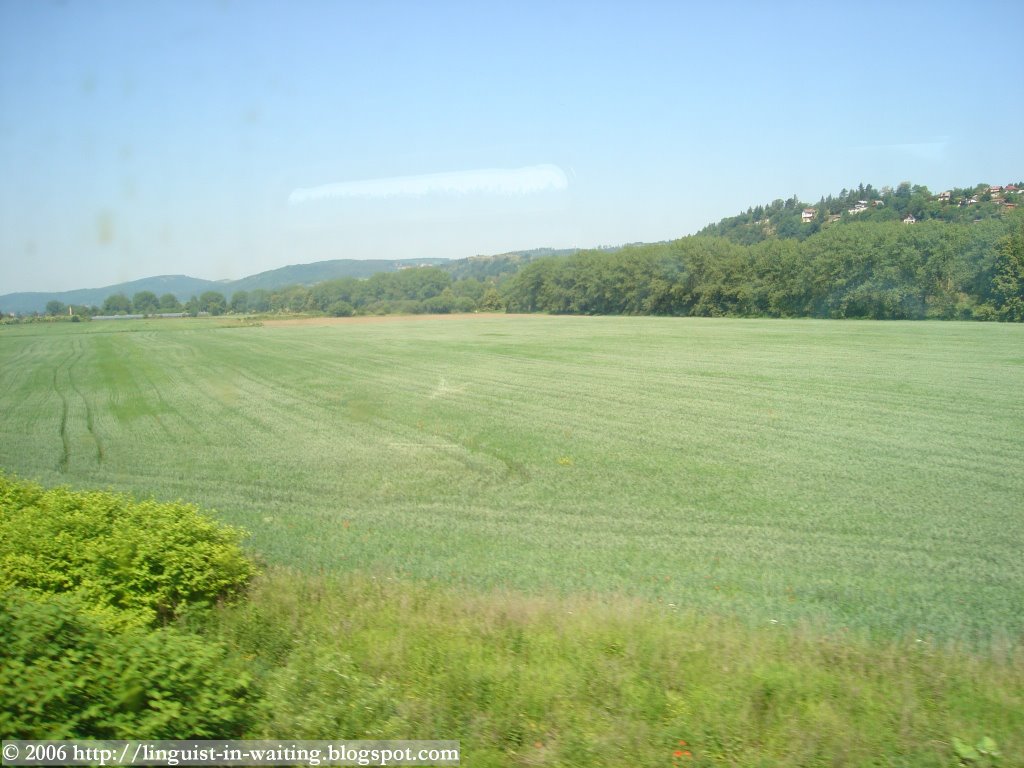
As you can see, it is the Czech countryside.

After thirty minutes, I arrived at Beroun Station.

Beroun - Koněprusy
I arrived at Beroun about a few minutes after 11:00. I followed the directions of my guidebook, and I needed to find the bus stop. From Beroun, I needed to take a bus to get me to the village of Koněprusy, which is about 6 kilometers from Beroun. I walked north from the station until I reached the main square, Husovo Náměstí.

I immediately noticed that the town is very clean, but I'll talk about this later. I then found the Town Information Center, and again, with my Czech, I asked where the bus stations are.
LIW: Dobry den, kde je zastávka pro autobusy do Koněpruské Jeskyně? Good day, where is the bus stop for buses going to Koněprusy Caves?
Lady: Jděte přímo a vpravo, prosim. Go straight ahead, then turn right.
LIW: Dekujeme. Thank you.
Lady: Prosim. No problem.
So I found the bus stop. I then learned that the next bus does not depart until 12:20 PM, so I had around an hour to burn. So I decided to walk to the nearest store, and I bought some bread, a yoghurt drink, and a 1.5 liter bottle of water, which then became my lunch.
At 12:20, the bus arrived, and I boarded it, and 20 minutes later, I found myself at the foot of the path that would lead to the entrance.
At Koněpruské Jeskyně
I walked a few hundred meters from the bus stop, and then I found the cash desk. I reached the cash desk at 1:05 PM, and paid the entrance fee. They said that I could enter the caves at 1:30 PM. That is because they don't want people to crowd inside the caves. And nobody gets in without a guide. Unfortunately, the guides only speak Czech, but they provide a laminated sheet of paper explaining the caves in English. So I got that, and read the sheet before I went in, thinking that it would be dark inside and there is no time to read. That turned out to be the wise thing to do.
At 1:30, the gates opened for me. The caves are in the middle of nowhere, as this picture shows.

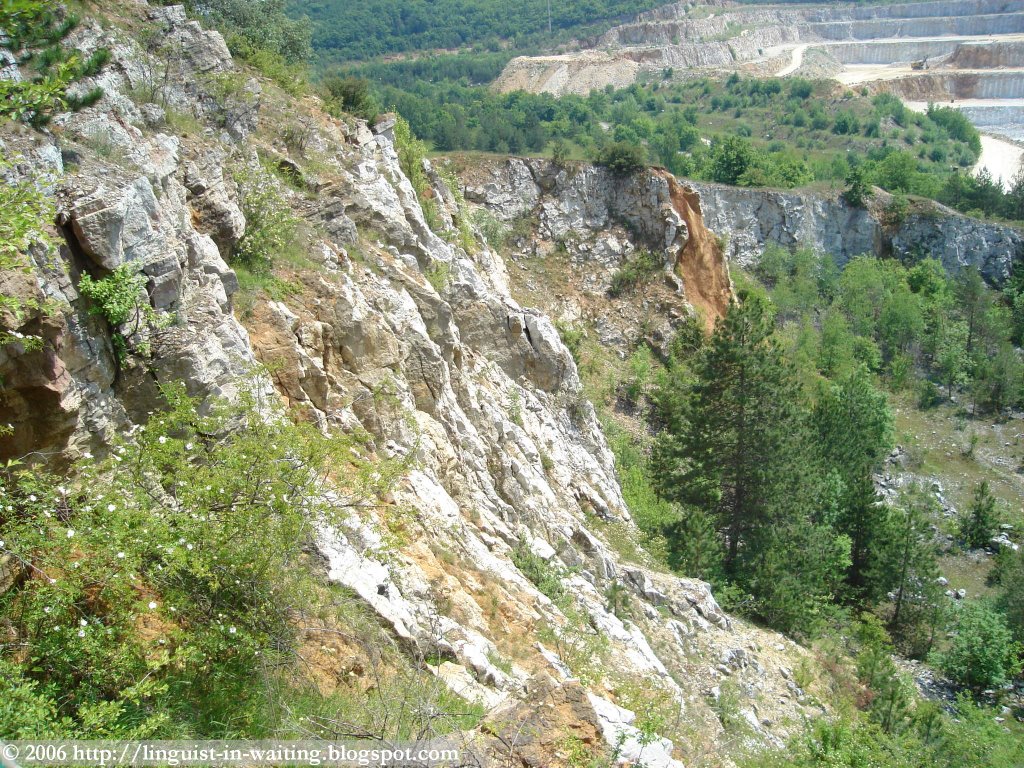
It was discovered in 1950 accidentally, because people were starting a mining quarry (thus the mining picture above), but when they hit the ravine, they discovered a cave system that happened to be the largest in Central Europe. Inside was the remains of a wholly rhinocerous, and a 15th century coin-forging laboratory.

Once inside, the temperature is a constant 10 degrees Celsius, thus, I found my jacket useful. There are seven large halls inside, and we went through each one of them.

Dim lights and sidebars line the path inside the 600-meter long cave system.
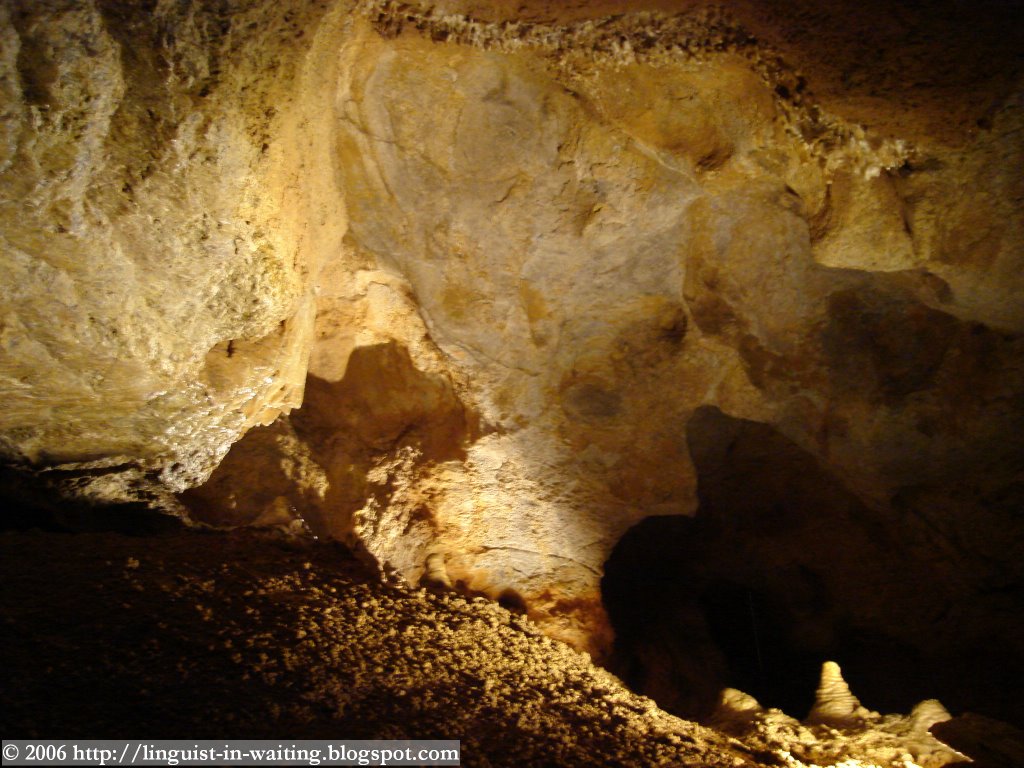

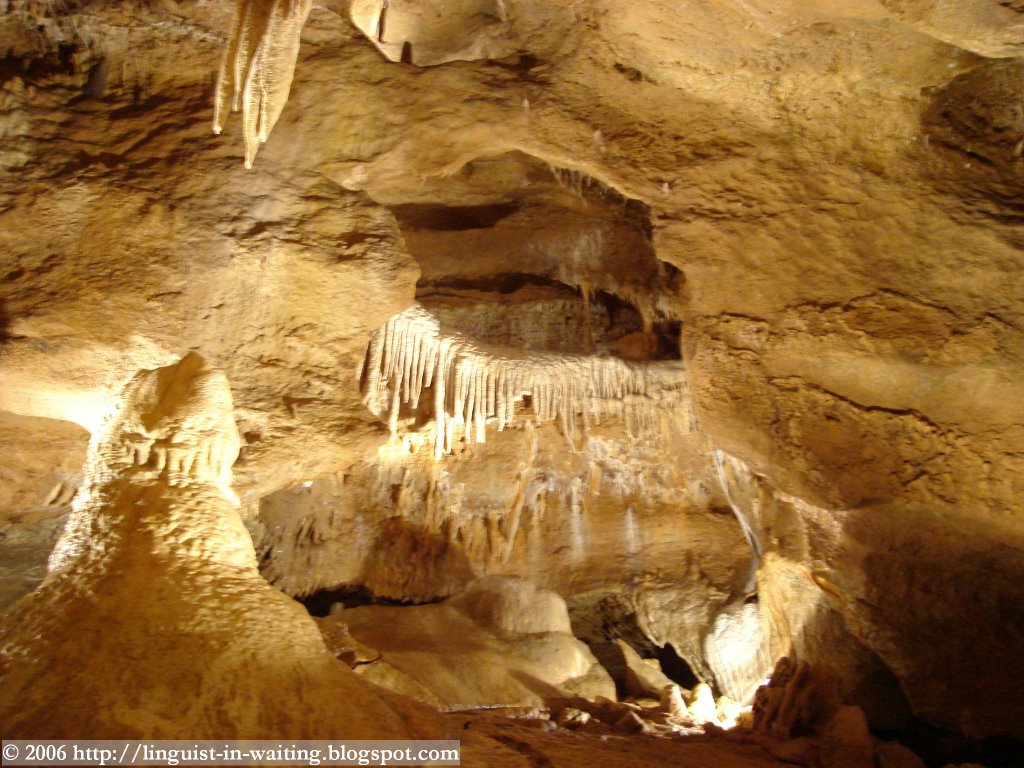
The picture above is from the Organ Hall. It is named that way because the stalactites make different sounds when tapped. Of course, in order to protect the caves, we weren't allowed to tap them.
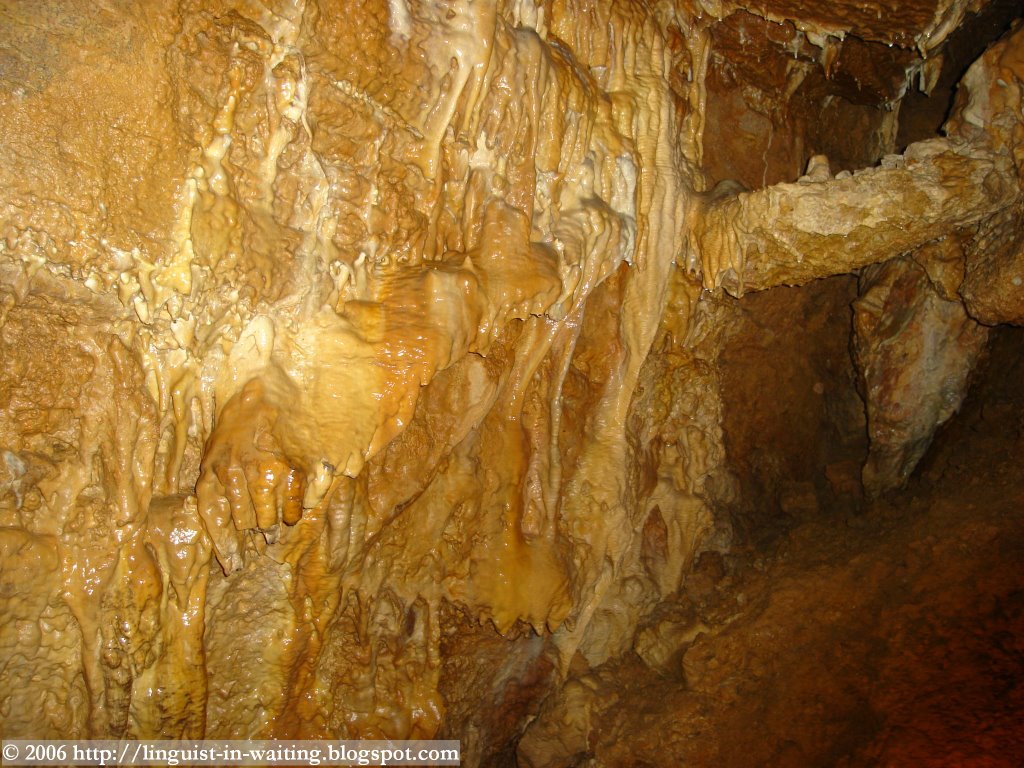


There are different formations inside, and everything was just magical. I never though I would be underneath the bowels of the earth in the middle of Bohemia.

As expected, the walls and the ceilings are wet, and the stalactites are constantly dripping with liquid.
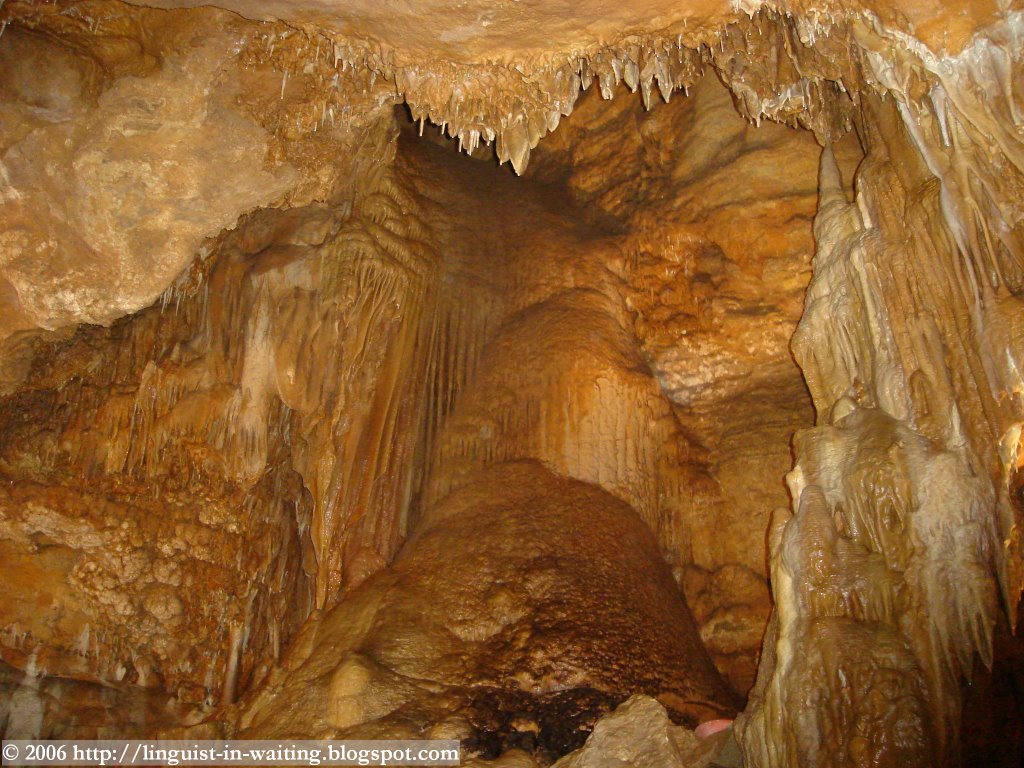

So after one hour and 600 meters of walking, I finished the tour of the largest cave system in Central Europe. Now it's time to go home.
Koněprusy - Beroun
I researched the departure times of the bus and trains long before I left home for the caves, so I knew that the next bus to depart Koněprusy for Beroun is at 3:30. And when I exited the caves, it was around 2:30. So I had an hour to waste.
I checked the souvenir shop, but there was nothing that strikes my fancy, so I didn't buy anything.
I walked back to the bus stop, and according to the time table there, the bus will depart at 3:57. So apparently, there is another bus stop where the return bus will depart about 20 minutes earlier. So I walked down the path in the middle of nowhere, and sure enough, I found the bus stop where the earlier bus departs from.
This is the picture of the surroundings, in the middle of nowhere. The sign says that I am 6 kilometers from Beroun town.

About 15 minutes before the bus came, two ladies and a toddler came close to me, and they spoke to me in Czech, apparently asking whether the bus for Beroun stops there. I told them I don't speak Czech, ironically, in Czech, but they gestured "autobus" and I tried my best to tell them that yes, buses for Beroun stop there.
So the bus came and we boarded. While in the bus, I took this picture of the Czech countryside, complete with haybales rolled up.
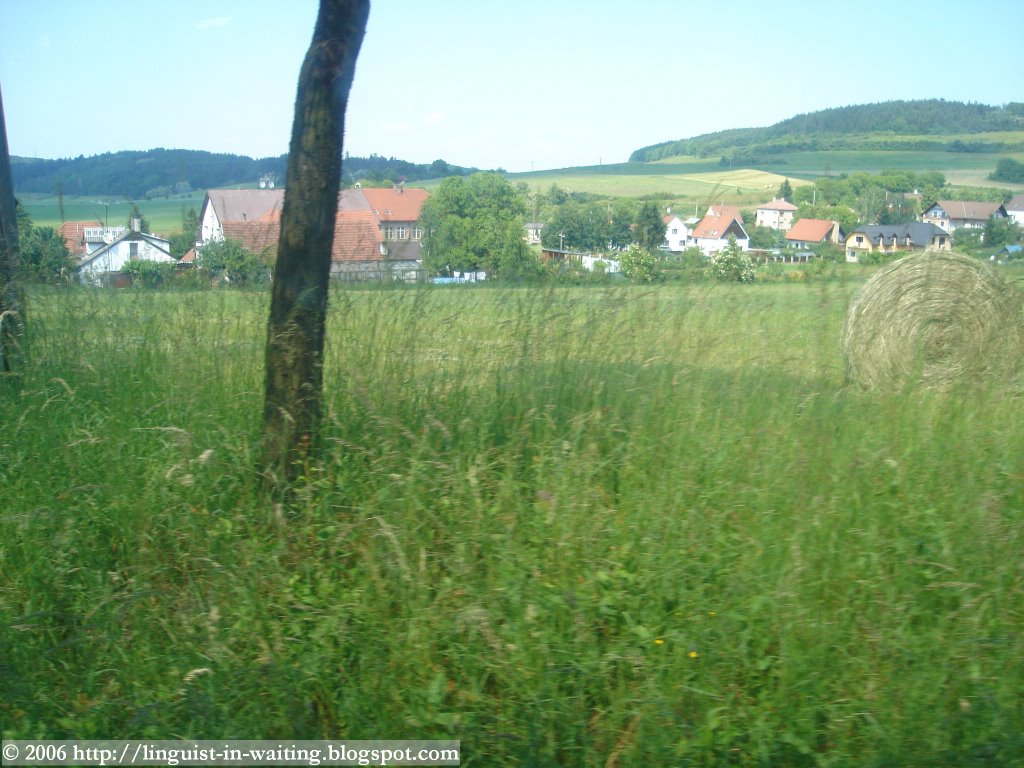
Again, after twenty minutes, I arrived in Beroun.
Beroun - Praha-Smíchov
Like I said before, the town of Beroun is very clean. This is due to the fact that very few tourists go here. In fact, I was the only foreigner in the caves. The majority of visitors are schoolchildren on field trips in chartered buses. Notice the cleanness of the town from these few shots.

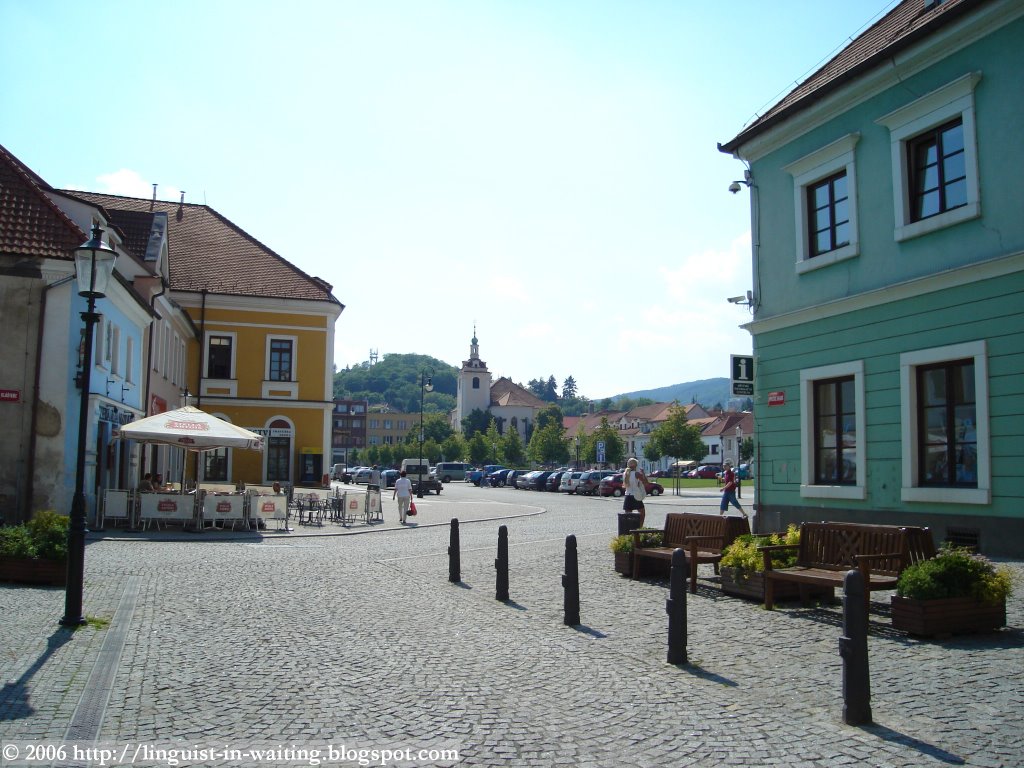
By the way, I noticed that the small flea market that was standing in the square was already put away when I arrived. How fast.
I then walked back to the train station, bought a ticket using the same routine, and boarded the first train out of Beroun, which was a local train (stopping at every stop along the way) which departs at 4:24, so I got back to Prague around ten minutes past 5:00 PM.
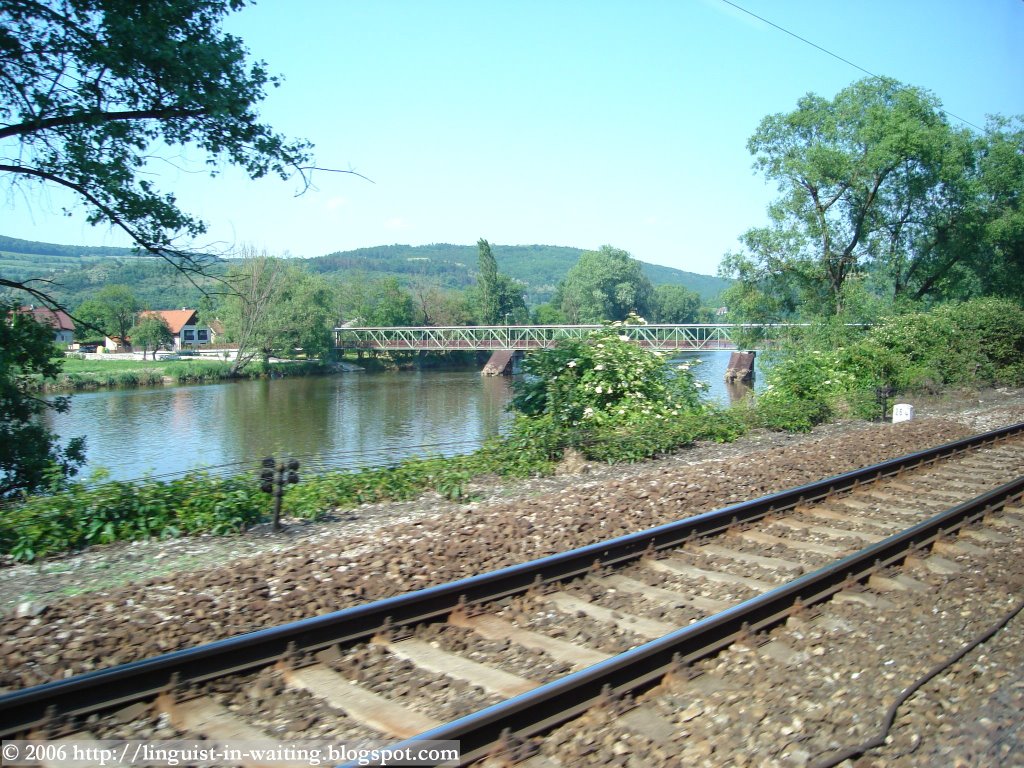
Finally, this was a shot I took of the scenery on the way back.
All in all, I enjoyed seeing the countryside, even though I cannot imagine myself living there. I loved the caves, it was my first time to be inside one. Enjoy the pictures.
Subscribe to:
Posts (Atom)